
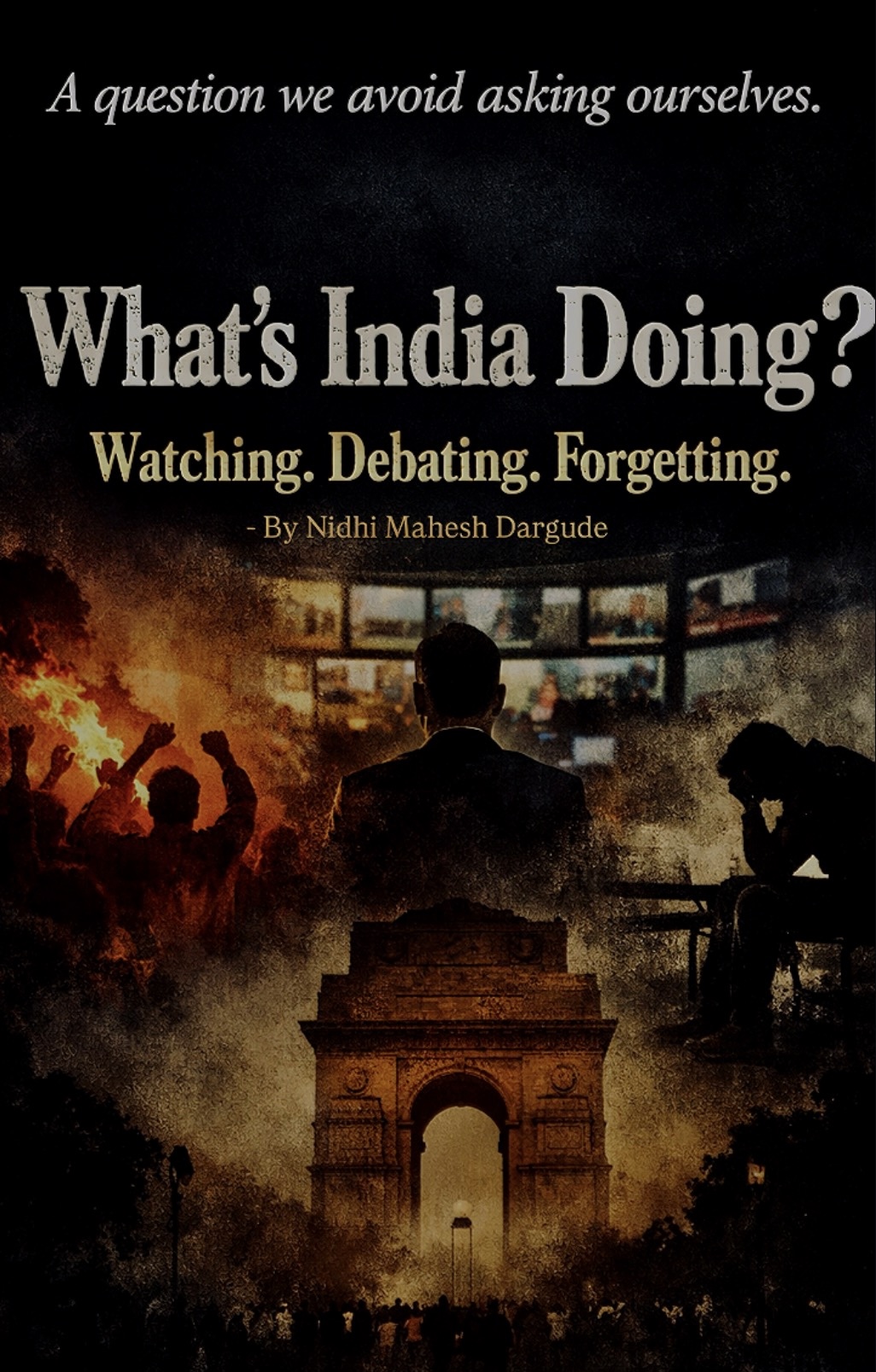
WATCHING. DEBATING. FORGETTING.
A Question we avoid asking ourselves.
Because asking is uncomfortable.
What’s India Doing?
A country full of opinions
India is not silent.
India is loud on television debates, social media threads, protest slogans, and dinner table arguments. Yet, beneath this noise lies an unsettling truth: we watch tragedies unfold, we argue over them endlessly, and then we forget.
Every few weeks, a new headline replaces the old. A crime shocks the nation, screens turn red with outrage, hashtags trend overnight, and prime-time debates compete to sound the angriest. For a moment, everyone becomes a judge, a psychologist, a policymaker. But justice is not delivered in noise it requires memory, responsibility, and action. And that is where we fail. India is always doing something mostly talking about it. This is a country where everyone has an opinion: on the Constitution, on crime, on women’s safety, on nationalism, on morality. WhatsApp University is more active than Parliament on some days, and prime-time debates have turned into competitive shouting leagues. Opinions are free, facts are optional.
Legally speaking, India guarantees freedom of speech under Article 19(1)(a) and we have taken that very personally. So personally that we speak before we read, judge before we verify, and cancel before we understand due process. The irony? The same crowd screaming “justice!” rarely waits for investigation, trial, or evidence. Presumption of innocence? Sorry, that doesn’t trend.
Everyone wants instant justice but no one wants to talk about overburdened courts, delayed trials, weak investigation, or custodial accountability. Those topics don’t make good reels. It’s easier to form opinions on accused persons than to question why FIRs are delayed, why witnesses turn hostile, or why conviction rates remain painfully low.
India isn’t short on outrage, it’s short on consistency. One case shakes the nation; another dies quietly because it doesn’t fit the preferred narrative. Public morality fluctuates depending on the religion, caste, gender, or political convenience of the people involved. Justice here is loud when cameras are on and strangely shy when they’re off.
As a law student, you start noticing the pattern early: opinions dominate where institutions fail. When trust in investigation, prosecution, and judiciary weakens, public judgment steps in—messy, emotional, and often dangerous. The law becomes a spectator while social media plays judge, jury, and executioner.
So what’s India doing?
Talking. Debating. Cancelling. Forgetting.
Because forming opinions is easy. Fixing systems requires patience, accountability, and something we struggle with deeply waiting for the law to do its job.
We Watch Everything
News, reels, clips, and chaos
India doesn’t just consume information anymore we binge it.
From breaking news to 15-second reels, from leaked CCTV clips to half-cut courtroom videos, we watch everything. Not to understand, but to react. Attention has replaced analysis, and outrage has become a form of entertainment. Tragedy loads faster when there’s background music and subtitles. News is no longer about facts; it’s about who shouts first. Prime-time debates resemble street fights with microphones, where volume wins and nuance loses. Reels simplify complex crimes into catchy captions, stripping cases of context, law, and most importantly human dignity. Investigation is ongoing, but public opinion is already delivered in HD.
Legally, this obsession comes at a cost. Media trials openly collide with the right to a fair trial under Article 21. Evidence is debated before it’s examined, accused persons are convicted by thumbnails, and victims are reduced to hashtags. Confidentiality, due process, and presumption of innocence are treated like outdated concepts that don’t perform well on the algorithm. We watch violence, humiliation, arrests, and grief like episodes in a series. And once the next case appears, we move on no follow-ups, no accountability, no interest in whether justice was actually served. Closure is optional; content is mandatory.
As a law student, it’s impossible not to see the damage. Clips don’t show chain of custody. Reels don’t explain procedural safeguards. And chaos doesn’t care about consequences. Yet we consume it all, convinced that watching equals awareness.
But watching everything has made us feel everything except responsibility.
Because in this country, information isn’t lacking
patience, legal literacy, and restraint are.
Breaking News, Broken Attention
Today’s tragedy, tomorrow’s trend
In India, tragedy doesn’t fade it expires.
“Breaking News” flashes across screens like a warning, but our attention breaks faster than the story itself. For a few hours, we care deeply. We tweet, repost, argue, demand justice in capital letters. And then another headline drops. New victim. New outrage. Same cycle.
The problem isn’t that people don’t care. The problem is that they don’t remember.
News channels keep showing a tragedy only till it boosts their TRPs, and the moment a new story comes in, they move on like nothing happened. Social media is even worse it runs on speed, not substance. Algorithms don’t care about follow-ups or justice; they care about what’s new.
Justice takes time. Investigations, trials, and accountability don’t happen overnight. And because justice is slow, it doesn’t hold attention. It doesn’t trend. So it gets ignored.
From a legal perspective, this obsession with immediacy is dangerous. Criminal law runs on investigation, evidence, and procedure, not on public impatience. But public pressure thrives on instant conclusions. We want arrests before inquiry, confessions before trial, and punishment before proof. Due process under Article 21 gets sacrificed at the seat of urgency.
Victims become symbols for a day. Accused persons become villains overnight. Both are stripped of complexity, dignity, and rights. And when the case stops trending, support systems disappear no legal aid follow-up, no witness protection conversation, no institutional reform.
As law students, we notice what others don’t: the real failure isn’t that news breaks it’s that attention doesn’t stay. Justice needs consistency, not viral spikes. It needs patience, not panic. But patience doesn’t trend.
So today’s tragedy becomes tomorrow’s forgotten headline.
And somewhere between the two, accountability quietly slips away
unnoticed, unbothered, unresolved.
Crime Is Now Daily Content
Shock first, scroll later
Welcome to India 2026: where criminal cases have become content and human tragedy is a feed, not a fight for justice.
Crime doesn’t shock us anymore it entertains us, briefly. A hineous murder flashes on our screens; we gasp, share a clip, comment some “justice please!” emoji, and then scroll. The next post? Another crime, another outrage, same scroll. Sympathy has an expiry date of 15 seconds.
From a legal perspective, this is toxic. Section 228A of the IPC protects victims’ identities but reels and news clips rarely care. Presumption of innocence?
Even the law seems to be on pause. Victims’ privacy is often ignored, and the accused are judged online before a single court hearing. People forget that everyone is innocent until proven guilty. Investigations, police work, court procedures all the things that actually matter get lost in the noise. Likes and shares decide the conversation, not facts.
Social media doesn’t reward patience or justice. It rewards speed, drama, and shocking content. The faster we react, the faster we move on. Real victims, real families, real consequences these don’t get the attention they deserve. What matters is how much the story can shock us before we scroll.
We have endless headlines, endless clips, endless outrage. But the real system the police, the courts, the lawyers keeps working quietly in the background. And most of us? We just keep watching, reacting, and scrolling. Justice waits, while we refresh our feeds for the next shocking story.
Rape: More Than Just a News Story
Fear, silence, and excuses
In India, rape is no longer just a crime it has become a headline. The story breaks, people react for a day or two, and then it disappears behind the next shocking post. But for survivors, it never ends. Fear doesn’t fade with trending hashtags. Silence doesn’t vanish with camera flashes. And excuses? They never stop.
Families are afraid to speak, victims are afraid to report, and society finds endless ways to blame the survivor instead of the criminal. From “she provoked it” to “why didn’t she fight back?”, the excuses are as common as the news itself.
The law is clear, but implementation struggles. Section 376 of the Indian Penal Code (IPC) punishes rape with rigorous imprisonment, Section 375 defines what constitutes rape, and Section 228A protects the identity of the victim. There are also Sections 354 (outrage of modesty) and 509 (word/gesture intended to insult the modesty of a woman), which cover harassment linked to sexual violence. But knowing the law is not enough the legal system moves slowly, victims face social stigma, and justice is often delayed.
Public outrage is loud, short-lived, and sometimes performative. People comment, share, hashtag, and forget. Meanwhile, survivors deal with trauma, fear, and a society full of excuses.
Rape is never “just a story.” It is a lived reality of fear, silence, and excuses. Until society treats it seriously and not as content justice will remain slow, and victims will continue to pay the price.
Murder and the Normalisation of Violence
Another body, another debate
In India today, murder has become almost… normal. Another life is lost, another headline flashes for a few hours, and then people move on. Outrage is temporary, debates are loud, but real change? Rarely happens. Tragedy becomes entertainment; human life becomes a scrollable story.
We debate motives, family backgrounds, caste, politics anything except the law itself. People argue online like experts, forgetting Sections 302 (punishment for murder), 304 (culpable homicide not amounting to murder), and 307 (attempt to murder) exist for a reason. Courts work, evidence is collected, witnesses testify but the public wants instant answers, quick justice, and social media satisfaction.
Violence is normalised because we see it every day. Films, news, social media clips they desensitise us. Another killing? Another debate. Another outrage? Another hashtag. Meanwhile, the legal system slowly moves through investigations, charges, and trials that take months or years. Real life isn’t a trend it doesn’t end when we scroll away.
As a law student, it’s clear: society reacts, debates, and forgets, while justice waits quietly, drowned in public opinion, delayed procedures, and media cycles. Violence becomes entertainment, and the victim is reduced to a statistic.
Threats Nobody Talks About
Power Works Quietly
In India, threats are everywhere but some are too quiet to make headlines. Not the obvious ones, not the loud public ones. These are the threats that come through private messages, anonymous calls, or leaked personal photos. And they usually target women.
Imagine this: your private photos are shared without consent, your messages are made public, and suddenly everyone knows things they shouldn’t. Instead of support, society blames you. People whisper, comment, judge but the real criminals? They hide behind screens, politics, or money. And the law? It exists Section 66E of the IT Act punishes violation of privacy, Sections 354D and 507 IPC punish stalking and criminal intimidation but enforcement is slow, selective, and often ineffective.
Public outrage is minimal because power works quietly. Influential people threaten, harass, or intimidate, and society looks the other way. Victims face isolation, fear, and a choice: stay silent or risk escalation. Threats aren’t just words they are tools used to control, shame, and scare people into submission.
As a law student, you notice the pattern early: the system protects the powerful better than it protects victims. Threats go unpunished, stories go unheard, and women learn to live in fear. And yet, society pretends everything is fine until the news breaks.
Moral? Threats are everywhere, but real danger hides in quiet spaces. And the louder we scroll, the softer justice gets.
When Planes Crash, Sympathy Has a Timer
Grief until the next headline
In India, when a plane crash happens, everyone cares at least for a little while. A big tragedy breaks on all channels, people post memories on social media, and then… as soon as the next big news arrives, our attention just moves on.
This is happening right now with Ajit Pawar’s tragic plane crash in Maharashtra (Jan 28, 2026). The Deputy Chief Minister of Maharashtra, Ajit Pawar, and four others died when their chartered aircraft crashed near Baramati during a landing attempt, bursting into flames on impact. Officials and political leaders have expressed grief and ordered investigations into what went wrong.
This isn’t the first time India has faced aviation tragedy. In 2025, Air India Flight 171 crashed soon after takeoff from Ahmedabad, killing hundreds of passengers and crew, and even people on the ground (only one survived) one of the deadliest aviation accidents in recent Indian history.
But what often happens is this: the first day is full of shock, the next days are full of condolences, and then a new story arrives. The news cycle moves faster than investigations. Detailed reports, causes, safety lessons, and the real emotional toll on families don’t get the same attention as the initial headlines.
We feel grief and we share it for a moment but sympathy on screens often expires quickly. Real change, reforms in aviation safety, long investigations, and support for families don’t trend as long as the next shock. That’s where the real gap is: between how long we pay attention and how long justice and accountability actually take.
Justice That Takes Its Own Time
Delayed, diluted, defended
In India, justice has its own clock and it is painfully slow. Cases pile up in courts, investigations take months or years, and by the time a verdict arrives, public interest has moved on. Yet, people keep debating, defending, or blaming, forgetting that the law works in its own way, not ours.
Sections like 304B (dowry death), 376 (rape), 302 (murder) are clear about punishment, but getting convictions is another story. Evidence gets lost, witnesses turn hostile, and technicalities dilute charges. Lawyers argue, judges deliberate, and meanwhile, families wait. Years pass, and what was once shocking becomes routine.
Society often defends this delay too. We say, “The system is slow, but that’s how it is,” as if inaction is acceptable. Meanwhile, the accused sometimes move freely, the guilty escape punishment, and victims are left counting time instead of getting justice.
A law student sees it clearly: the law has teeth, but bureaucracy and loopholes tie them up. Justice is not absent it’s just slow, messy, and selective. And while we wait, people forget the victims, debate the story, and move on.
Everyone Debates, Nobody Acts
TV Panels vs Real Life
In India, we are experts at debating but not at doing. Every crime, every scandal, every tragedy comes with a chorus of opinions: politicians comment, journalists argue, TV panels shout, social media explodes. Everyone has a verdict before evidence, before investigation, sometimes even before the incident is fully understood.
Sections like 302 (murder), 376 (rape), 498A (dowry harassment) exist in the IPC, but their proper use requires action, not chatter. The law doesn’t work with hot takes; it works with investigation, procedure, and evidence. Yet, the louder the debate, the slower the action often becomes. Real-life victims wait, accused walk free for months or years, and institutions police, courts, government bodies move at their own pace, quietly doing the hard work.
Meanwhile, TV panels debate endlessly. Experts argue, anchors shout, hashtags trend but action? That is invisible. Complaints are filed, investigations start, victims fight bureaucracy and by the time something happens, people have moved to the next scandal. Real justice doesn’t trend. Loud opinions do.
As a law student, it’s obvious: debating feels productive, but it isn’t. Change requires action, accountability, and follow-up, none of which make good TV. So we watch, argue, and scroll, while life, law, and victims wait patiently in the background.
Media Noise and Moral Confusion
What Matters and What Sells
In India, news isn’t just reported it’s packaged, edited, and sold. The loudest stories grab attention, the most shocking videos go viral, and the quiet, important issues get ignored. A politician’s scandal trends for days, a crime video goes viral in minutes, but investigations, social reforms, or legal follow-ups rarely make the headlines.
Sections like 302 (murder), 376 (rape), 498A (dowry harassment) exist to protect citizens, but media rarely focuses on how the law works. Instead, the focus is on drama, speculation, and outrage. People are confused about what actually matters, because moral outrage is often replaced by entertainment. Who is punished? Who is safe? Who is accountable? The news doesn’t answer these it just sells attention.
As a law student, the pattern is clear: public outrage is often performative. Social media amplifies drama, TV debates exaggerate the spectacle, and the real work of justice happens quietly in courtrooms, police stations, and legal offices far from trending hashtags.
In short: what sells is loud, what matters is quiet, and we keep scrolling, clapping, and commenting while justice, morality, and accountability wait in the background.
Anger That Lasts 24 Hours
Outrage with an Expiry Date
In India, outrage is fast, loud, and… short-lived. Something shocking happens a crime, a scandal, a tragedy and everyone reacts. People post on social media, TV panels shout, hashtags trend. For a few hours, anger is everywhere. Then… it disappears. The next headline comes, and suddenly, yesterday’s outrage is forgotten.
The law doesn’t work in 24 hours. Sections like 376 (rape), 302 (murder), 498A (dowry harassment) need investigation, evidence, and time. But society wants instant justice. People comment, share, and feel like action is happening but the truth is, real work is slow, quiet, and often invisible. Victims wait. Accused walk free. Cases drag on.
As a law student, it’s obvious: public anger is performative. The louder the outrage, the shorter it lasts. Real justice doesn’t fit into a timeline of trending topics. And while society moves on, the people affected are still living with consequences fear, trauma, and uncertainty.
In India, anger has an expiry date. Justice doesn’t.
Who Is Actually Responsible?
The System, the People, or Both
In India, everyone likes to blame someone except themselves. When a crime happens, people argue: “The system failed!” “Society is corrupt!” “The politicians don’t care!” But rarely do we pause to ask: what about us?
The law exists. Sections like 302 (murder), 376 (rape), 498A (dowry harassment), and IT Act provisions protect citizens. Police investigate. Courts deliver verdicts. But the system works slowly. Case backlogs, weak investigations, and loopholes allow crimes to continue. That’s one side of responsibility.
The other side? People. We watch crimes online, share videos, debate endlessly, but take no real action. Victims wait while we scroll. Outrage peaks and expires in 24 hours. We protect the powerful with silence, gossip the weak, and treat tragedy like entertainment.
So who is responsible? Both. The system delays, ignores, and sometimes protects the guilty but people fuel the cycle by caring only when it’s convenient, performing outrage instead of demanding accountability, and forgetting victims the moment the next story breaks.
As a law student, it’s clear: justice is a shared duty. Laws, institutions, and public attention must all work together. Right now, only one of them is trending and it’s not justice.
Remembering Is Also a Choice
And Forgetting Is One Too
In India, memory is selective. We remember tragedies, crimes, and scandals… but only for as long as they’re trending. A big story breaks, social media erupts, TV channels cover it endlessly and for a few days, everyone “cares.” Then a new headline arrives, and the old one is gone. Forgotten. Ignored. Moved past.
Justice doesn’t work that way. Sections like 302 (murder), 376 (rape), and 498A (dowry harassment) take time, evidence, and follow-up. Victims wait. Families suffer. Investigations move slowly. But public attention is fast. Outrage has an expiry date, sympathy fades, and society chooses to scroll.
Choosing to remember means demanding accountability, following up, and refusing to let tragedy become just another story. Choosing to forget is easier: scroll, like, comment a bit, and move on. Most of us choose the latter. And while we forget, victims continue living with fear, trauma, and injustice.
As a law student, it’s obvious: remembering is not passive its responsibility. Forgetting is not innocent it’s complicity. India forgets too often, and that is why justice often comes too late.
Conclusion: Watching, Debating, or Doing Something About It?
The Answer Decides Everything
After all the outrage, all the news, all the hashtags and debates… what actually changes? Nothing, unless someone acts. Watching is easy. Debating is satisfying. Doing something is hard. But only action makes a difference.
We all need to stand together society, citizens, and institutions. We need to demand accountability, follow through on cases, support victims, and make sure the law actually works. Outrage without action is useless. Watching isn’t enough. Debating isn’t enough. Only collective action standing up, speaking out, insisting on justice can make a difference.
As a law student, my point of view ? I see the loopholes, the delays, and the excuses. I see the system failing and people pretending it’s fine. But if we stand together, notice the problems, and push for change, maybe just maybe we can make outrage last longer than 24 hours and justice reach those who need it most.